

7 Common Mistakes That Cause Traders to Fail Prop Firm Challenges (And How to Avoid Them)
Discover the 7 most common mistakes that cause 80% of traders to fail prop firm challenges. Learn how to avoid these pitfalls and successfully pass your evaluation with proven strategies.
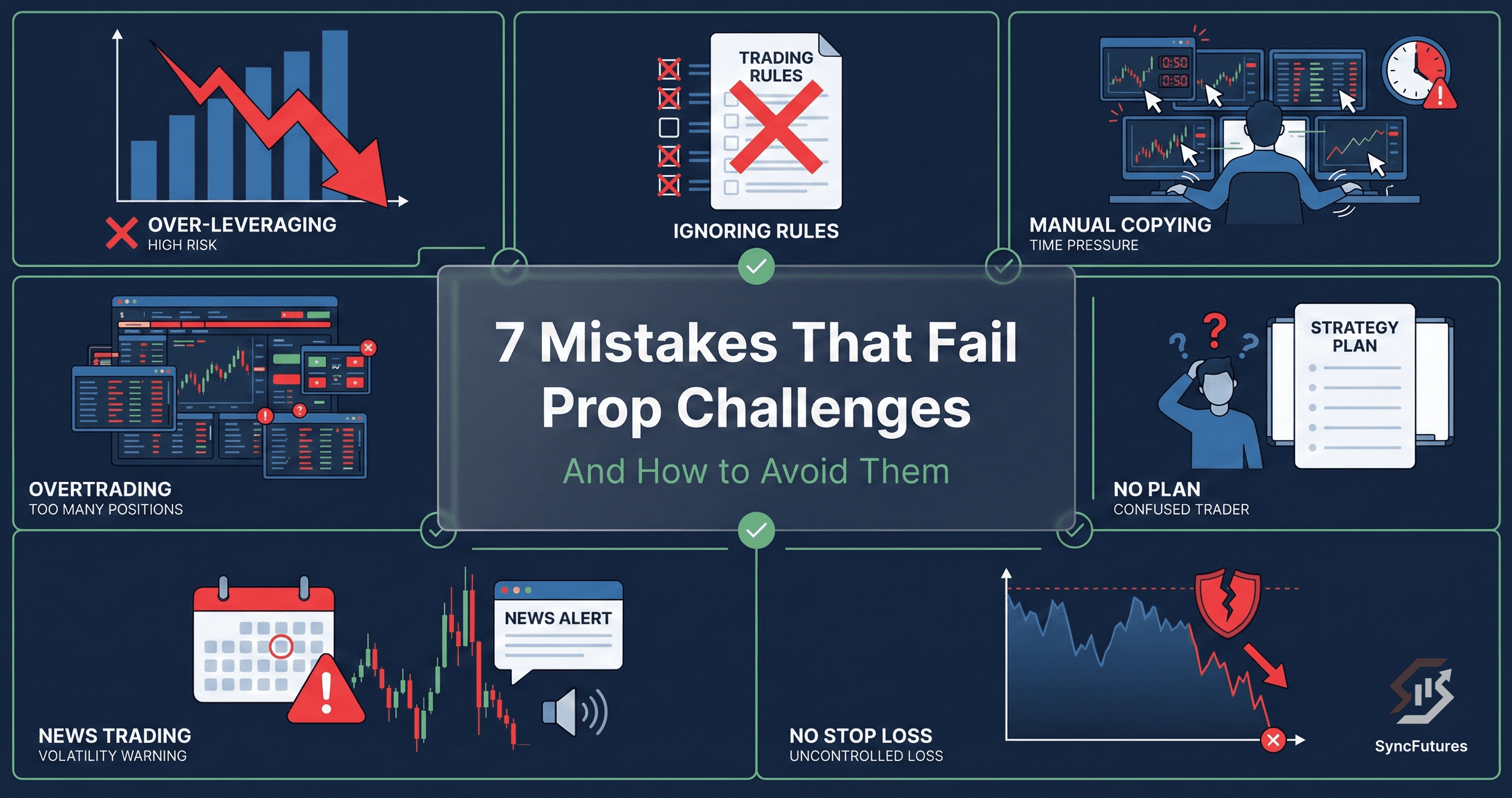
Introduction
Over 80% of traders fail their first prop firm challenge. But here's the surprising truth: it's rarely because they can't trade.
Most failures don't come from bad strategies or lack of market knowledge. They come from simple, avoidable mistakes—discipline failures, rule violations, and poor risk management decisions that could have been prevented with the right preparation. The difference between passing and failing a prop firm evaluation often has nothing to do with trading skill and everything to do with avoiding these critical pitfalls.
This guide reveals the 7 most common mistakes that cause traders to fail prop firm challenges—and more importantly, shows you exactly how to avoid them. Whether you're attempting an evaluation with Apex Trader Funding, Topstep, Bulenox, Take Profit Trader, or any other prop firm, these insights will dramatically improve your chances of earning that funded trader account.
Why Do So Many Traders Fail Prop Firm Challenges?
The statistics are sobering. Industry estimates suggest that 80-90% of traders fail their first prop firm challenge. Some firms report even higher failure rates during particularly volatile market conditions.
But before you get discouraged, understand this: the prop firm evaluation process is designed to filter out undisciplined traders, not skilled ones. Prop firms need to identify traders who can follow rules, manage risk properly, and trade with consistency under pressure. The challenge structure—profit targets, daily loss limits, maximum drawdown rules, minimum trading days—creates an environment where lack of discipline becomes impossible to hide.
Here's the encouraging part: most failures share the same root causes. It's not that failing traders don't understand technical analysis or can't read price action. They over-leverage. They ignore the rules. They revenge trade after losses. They try to copy trades manually across too many accounts and make execution errors.
The common thread? These mistakes are 100% preventable.
You don't need to be a better trader to pass a prop firm challenge. You need to be a more disciplined trader. You need to avoid the specific mistakes that cause 80%+ of failures. That's exactly what this guide will help you do.
Mistake #1: Over-Leveraging and Poor Position Sizing
The Problem
This is the number one killer of prop firm challenges. Traders use position sizes that are far too large relative to their account size, trying to hit profit targets quickly. The logic seems sound: "I need 10% profit in 30 days, so if I risk 5% per trade, I only need two winning trades."
One bad trade destroys that plan. One unexpected market move, one stop loss hit, and you've blown through your maximum daily loss limit or violated your drawdown threshold. Your challenge is over.
Example scenario: You're trading an Apex Trader Funding 50K evaluation. You need $3,000 profit (6% of the initial balance) to pass. You decide to risk $2,000 per trade, thinking you only need two good trades to pass. On your third trade, the market moves violently against you. Your stop loss is hit. You're down $2,000—which violates the daily loss limit. Challenge failed.
Why This Happens
The pressure to hit profit targets fast drives poor decisions. After a couple winning trades, overconfidence sets in. You start thinking "I've got this" and increase position size. Or you see a "perfect setup" and decide to risk more than usual "just this once."
The prop firm challenge structure creates urgency. You have 30 days, or 60 days, or whatever the time limit is. That deadline creates psychological pressure to trade bigger, trade more, and take unnecessary risks.
How to Avoid It
Never risk more than 1-2% of your account per trade. This isn't optional advice—it's the foundation of passing a prop firm challenge.
Let's do the math for a typical evaluation:
- Account: Apex Trader Funding $50K evaluation
- Profit target: $3,000 (6%)
- Max daily loss: $2,000
- Max trailing drawdown: $2,500
If you risk 1% per trade, that's $500 per trade. To hit your $3,000 profit target with a 50% win rate:
- 6 winners = $3,000 profit
- 6 losers = $3,000 loss
- Net: Break even after 12 trades
But you don't need a 50% win rate to pass. You need risk/reward ratios that favor you. If your average winner is 2x your average loser:
- 4 winners at $1,000 profit = $4,000
- 6 losers at $500 loss = $3,000
- Net: $1,000 profit after 10 trades
The 1% rule means you need 4 decent winning trades to pass—not home runs, just solid trades with good risk/reward.
Calculate position size BEFORE entering every trade:
- Determine your risk amount (1% of account = $500 on a $50K account)
- Identify your stop loss distance in ticks/points
- Calculate position size: Risk Amount ÷ (Stop Distance × Dollar Per Tick)
Example for ES futures:
- Risk: $500
- Stop distance: 10 points
- ES dollar value: $50 per point
- Position size: $500 ÷ (10 × $50) = 1 contract
If you calculate 3.5 contracts, round DOWN to 3 contracts. Never round up—always err on the side of smaller position sizes.
Mistake #2: Not Reading the Rules Carefully
The Problem
Every prop firm has different rules. Traders skim the terms and conditions, think they understand the basics, and start trading. Then they violate a rule they didn't know existed. The prop firm disqualifies them instantly—no second chances, no refunds for rule violations.
You might be a profitable trader who would have easily passed the evaluation, but you traded during a prohibited news event, or held a position overnight when the rules forbid it, or exceeded a daily trading limit you didn't know about. None of those mistakes reflect your trading ability, but all of them end your challenge immediately.
Common Rule Violations
Trading During News Events
Some prop firms prohibit trading during high-impact economic news releases. You might not even realize you're in violation—you enter a position 10 minutes before NFP (Non-Farm Payroll) data, and the firm flags your account for a rule violation.
Holding Positions Overnight
Many prop firm challenges require you to close all positions before the market closes. If you forget and leave a position open overnight, that's often an automatic disqualification—even if the position is profitable.
Exceeding Maximum Daily Loss
This seems obvious, but the calculation can be tricky. Some firms calculate daily loss from your starting balance. Others calculate it from your highest balance during the day. If you're up $500 and then lose $2,000, did you hit your $2,000 daily loss limit, or did you lose $2,500 from your high point? Know how your firm calculates this.
Not Meeting Minimum Trading Days
Some evaluations require you to trade a minimum number of days (e.g., 5 days out of 30). You hit your profit target on day 3 and stop trading, thinking you've passed. But you haven't met the minimum trading day requirement, so you fail.
Using EAs or Bots (When Prohibited)
Most prop firms allow manual trading only—no Expert Advisors, no automated bots, no algorithmic systems. However, most firms DO allow trade copiers for replicating manual trades across multiple accounts. Know the difference and verify what your specific firm permits.
How to Avoid It
Read ALL rules before starting your evaluation. Not just the main terms—read the FAQs, the knowledge base articles, and any rule clarification documents.
Print the rules and keep them visible. Put them next to your monitor. Reference them before every trading session.
Create a checklist of do's and don'ts:
✅ DO:
- Close all positions before market close (if required)
- Trade only during permitted hours
- Stay well below daily loss limits
- Track your trading days to meet minimums
- Use trade copiers if managing multiple accounts (most firms allow this)
❌ DON'T:
- Trade during prohibited news events
- Hold overnight positions (if not allowed)
- Exceed maximum position sizes
- Trade prohibited instruments
- Use automated trading bots (unless explicitly permitted)
When in doubt, contact support BEFORE trading. Five minutes asking a question could save you thousands of dollars in evaluation fees.
Common rules checklist for major prop firms:
| Prop Firm | Daily Loss Limit | Max Drawdown | Overnight Holds | News Trading | Trade Copiers |
|---|---|---|---|---|---|
| Apex Trader Funding | Varies by account | Trailing drawdown | Allowed between sessions | Usually allowed | Allowed |
| Topstep | Varies by account | EOD drawdown | Not allowed | Allowed with restrictions | Allowed |
| Bulenox | Varies by account | Trailing or EOD | Check rules | Check rules | Allowed |
Always verify current rules with your specific prop firm, as policies can change.
Mistake #3: Manual Trade Copying Across Multiple Accounts
The Problem
You passed your first evaluation. Congratulations! Now you've got five funded accounts from Apex Trader Funding. Then you pass three more challenges with Topstep. Now you're managing eight funded accounts—maybe soon to be ten or fifteen.
This is exactly what you wanted: the ability to scale your trading income. One good trading strategy across ten accounts means 10x the profit potential.
But here's the problem nobody warns you about: you execute your trade on account 1, then switch to account 2, then account 3. By the time you reach account 5, the market has moved two ticks against you. You're getting different fills on each account. Accounts 6 through 10? You either miss the entry entirely, or you're entering at significantly worse prices.
Real scenario:
You spot a perfect ES futures setup. You're trading the breakout and enter your first account at 4525.00. You switch platforms, log into account 2, enter at 4525.25. Switch to account 3, enter at 4525.50. By the time you finish copying the trade to accounts 8, 9, and 10, ES is trading at 4527.00.
You meant to enter all accounts at the same price with the same risk profile. Instead, your first account has a good entry, accounts 2-5 have mediocre entries, and accounts 6-10 are already underwater. Your risk management is inconsistent across accounts. One mistake on one account—entering the wrong quantity, forgetting a stop loss, fat-fingering an order—puts that entire funded trader account at risk.
Why This Happens
Prop firms encourage scaling. Apex allows up to 20 funded accounts. Topstep permits 10+. Bulenox, Take Profit Trader, My Funded Futures—they all allow multiple funded accounts per trader because they know that professional traders scale their strategies.
But manual trade copying doesn't scale. Human execution speed and accuracy break down after 3-4 accounts. The time lag between executions increases. Errors compound. Mental fatigue sets in.
You're trying to solve a technology problem with manual effort—and it doesn't work.
How to Avoid It
Use a professional trade copier designed for futures trading. This is not optional if you're serious about managing multiple prop firm accounts.
A trade copier automates the replication of your trades from one master account to unlimited follower accounts. You trade normally on your master account—the same way you always have. The trade copier monitors that account and replicates every action to your followers in real-time.
Benefits of automated trade copying:
- Execute once, replicate everywhere: Take your trade on the master account, watch it instantly appear on all follower accounts
- Sub-second synchronization: Millisecond replication means all accounts get nearly identical fills
- Consistent position sizing: Set multipliers for each account based on size, and the copier automatically calculates correct quantities
- Automatic stop loss replication: Risk management copies to all accounts without manual entry
- Focus on strategy, not mechanics: Your mental energy goes to trading, not clicking buttons
Want to dive deeper? Read our complete guide: How to Copy Trades Across Multiple Prop Firm Accounts
Brief mention of SyncFutures:
SyncFutures solves this exact problem for prop firm traders. Connect your Tradovate, Rithmic, or NinjaTrader accounts through a cloud-based dashboard. Set your copy rules once. Start trading on your master account, and watch your trades replicate across all follower accounts with millisecond synchronization. No VPS required, no software to install, no manual copying.
Whether you're managing 5 accounts or 20, the operational complexity stays the same: you trade one master account, and technology handles the rest. Learn more about our trade copier features.
Mistake #4: Overtrading to Hit Profit Targets
The Problem
Your evaluation has clear targets: 10% profit in 30 days. Simple enough. But as the days pass, pressure builds. You're on day 20 and only up 4%. You need 6% more profit in 10 days. The math creates urgency: "I need to trade more to hit my target."
So you start taking marginal setups. You trade outside your usual market sessions. You enter positions that don't quite meet your criteria because "I need the profit." Your quality standards drop. Your discipline weakens. You start revenge trading after losses because you "can't afford" to stay flat.
More trades mean more opportunities to violate rules. More trades mean more chances to hit your daily loss limit. More trades mean mental fatigue that leads to mistakes.
Why This Happens
The profit target creates a finish line mentality. In normal trading, you take your best setups and let probabilities work over time. In a prop firm challenge, you're racing against a deadline. That urgency makes bad setups look tempting.
Fear of running out of time drives overtrading. So does revenge trading—you lose on a trade and immediately look for another trade to "get it back" instead of waiting for your next quality setup.
There's a dangerous confusion between activity and progress. Taking 10 trades feels productive. Sitting on your hands waiting for the perfect setup feels like you're not trying hard enough. But in trading, doing nothing is often the highest-probability play.
How to Avoid It
Quality over quantity. You're not graded on number of trades. You're graded on net profit while staying within risk parameters.
Stick to your highest-probability setups only. If a setup doesn't meet your normal criteria, don't take it just because you're in a challenge. The pressure to pass doesn't change what makes a good trade.
Set daily trade limits. Example: Maximum 3 trades per day. This forces you to be selective. You can't waste trades on marginal setups if you only get three chances.
If you hit your daily loss limit, STOP immediately. Close your platform. Walk away. The worst prop firm failures happen when traders try to "trade their way out" of a red day. You can't recover from violating your daily loss limit.
Remember: You only need 10%, not 100%. Let's break down the actual math:
- Target: 10% in 30 days
- Daily average needed: 0.33% per day
- With 1% risk per trade: You need one 3:1 risk/reward winner every 3 days
That's it. One quality trade every few days. You don't need to trade every day. You don't need multiple setups per session. You need patience, discipline, and the occasional high-quality trade.
Mistake #5: Trading Without a Clear Plan
The Problem
You start your prop firm challenge with excitement and confidence. You know how to trade—you've been profitable before. So you jump straight in without writing down your specific entry criteria, exit rules, position sizing strategy, or risk management guidelines.
You're trading reactively instead of proactively. Each setup is evaluated in the moment based on how it "feels." Your entries are inconsistent. Your stop losses vary. Your position sizing changes based on how confident you are.
This approach might work occasionally. But over 30-60 days of trading under pressure, inconsistency guarantees failure.
Why This Happens
Excitement to start earning makes traders skip the planning phase. There's also overconfidence—"I've been trading for years, I don't need to write this down."
Some traders rely on intuition and feel rather than defined criteria. That works for experienced discretionary traders—until the pressure of a prop firm challenge creates emotional interference. Suddenly your "feel" is clouded by urgency, fear, and the need to hit targets.
How to Avoid It
Write down your complete trading plan BEFORE starting your evaluation.
Your plan should include:
Entry Criteria:
- Specific setups you trade (list them explicitly)
- Market conditions required (trend, range, volatility)
- Confirmation signals needed before entry
- Time of day you trade (avoid outside your optimal hours)
Exit Criteria:
- Stop loss placement rules (how many ticks/points, based on what?)
- Profit target strategy (fixed targets, trailing stops, or discretionary exits?)
- Break-even rules (when do you move stops to entry?)
Position Sizing:
- Risk percentage per trade (1% recommended)
- Maximum position size regardless of setup
- How to calculate contracts based on stop distance
Risk Management:
- Daily loss limit (set yours lower than the firm's limit for safety margin)
- Maximum number of trades per day
- Rules for when to stop trading (consecutive losses, daily loss near limit, etc.)
Example planning template:
TRADING PLAN - Prop Firm Challenge
Setups I Trade:
- ES Opening Range Breakout (first 30 min)
- NQ Trend Continuation Pullback (9:45-11:30 AM)
- ES Support/Resistance Breakout (any time)
Entry Rules:
- Must have [specific confirmation signal]
- Must occur during [specific hours]
- Must meet [specific criteria]
Exit Rules:
- Stop loss: [X points/ticks based on setup]
- Profit target: [Y points/ticks, or trailing stop rule]
- Move to break-even after [Z points/ticks profit]
Position Sizing:
- Risk 1% of account per trade
- Calculate: Account × 1% ÷ (Stop Distance × Dollar Per Point)
- Maximum: [X contracts regardless of calculation]
Daily Limits:
- Maximum 3 trades per day
- Stop trading after 2 consecutive losses
- Stop trading if down [amount] for the day
- Stop trading if daily loss approaches [X% of limit]
Backtest your strategy first. Use historical data or a replay platform to verify your plan works over 50-100 trades. This builds confidence and reveals any flaws before you risk real evaluation money.
Paper trade your strategy for one week minimum. Practice executing your plan in live market conditions without financial risk. This identifies any gaps in your rules and builds mechanical consistency.
Mistake #6: Trading During Major News Events
The Problem
NFP Friday. FOMC announcement day. CPI release morning. These high-impact economic news events create massive volatility in futures markets. Spreads widen. Prices gap. Liquidity evaporates for seconds at a time.
Some prop firms explicitly prohibit trading during major news events. If you trade during these times, you're violating rules—instant disqualification.
Even if your firm allows news trading, the volatility makes risk management nearly impossible. Your 10-point stop loss might get blown through by a 30-point spike in one second. Your daily loss limit? Violated in a single news candle. Your prop firm challenge? Over.
Common Prohibited Times
Different firms have different news trading rules, but these events commonly require caution:
High-Impact U.S. Economic Data:
- NFP (Non-Farm Payroll): First Friday of each month, 8:30 AM ET
- CPI (Consumer Price Index): Monthly, usually mid-month, 8:30 AM ET
- FOMC (Federal Reserve) Announcements: Eight times per year, 2:00 PM ET
- GDP Reports: Quarterly, 8:30 AM ET
- Unemployment Claims: Weekly, Thursday 8:30 AM ET
Other High-Impact Events:
- Central bank decisions (Fed, ECB, BOE, etc.)
- Presidential speeches on economic policy
- Geopolitical crisis events
How to Avoid It
Check your prop firm's specific news trading rules. Look for explicit guidance:
- "No trading 5 minutes before/after high-impact news"
- "Close all positions before FOMC announcements"
- "News trading allowed but at your own risk"
Use an economic calendar. Bookmark one or more of these:
Set up alerts for high-impact news events (marked with red folder or "3" impact level). Know what's coming each day before you start trading.
General safety rules:
- Close all positions 15 minutes before major news releases
- Wait 15 minutes after the news for volatility to settle before entering new trades
- If you're in a position when unexpected news breaks, close immediately—don't try to "ride it out"
- When in doubt, sit out
Your evaluation will be there after the news event passes. Missing one trading session to avoid news volatility is far better than blowing your account on a CPI spike.
Mistake #7: Not Using Stop Losses
The Problem
"I'll just watch the position and close it manually if it goes against me."
Then your internet disconnects. Or you get distracted by a phone call. Or the market moves faster than you can click. Or you freeze, hoping the position will turn around—classic deer-in-headlights psychology.
Without a stop loss, you have uncontrolled risk. One big move against you can violate your daily loss limit in seconds. In futures markets where leverage is high and prices move fast, trading without stop losses is gambling, not trading.
Why This Happens
Some traders believe stop losses get "hunted" by market makers or algorithms. They think they'll get better exits by managing manually.
Others have overconfidence in their ability to manage risk on the fly. "I've got quick reflexes. I'll close it if needed."
And some traders simply hate taking small losses. Setting a stop loss means admitting the trade might fail. Not setting a stop loss creates the illusion that you can avoid the loss through monitoring.
All of these rationalizations lead to the same result: blown accounts.
How to Avoid It
ALWAYS use stop losses. No exceptions. This is non-negotiable for prop firm challenges.
Set stops immediately when entering a position. The sequence should be:
- Enter position
- Set stop loss (immediately, same order ticket if possible)
- Set profit target (if using one)
Don't enter the trade and tell yourself you'll add the stop "in a second." Do it now.
Use hardware/broker-level stop losses. Don't use mental stops. Don't rely on stop loss indicators in your charting software. Place the actual stop loss order with your broker so it executes even if your computer crashes or your internet disconnects.
Calculate stop loss based on 1% risk:
Example for ES futures on $50K account:
- Risk amount: $500 (1% of $50K)
- ES point value: $50 per point
- Stop distance: $500 ÷ $50 = 10 points
- Entry: 4500.00
- Stop loss: 4490.00 (for long) or 4510.00 (for short)
If your stop is hit, accept it and move on. Stop losses exist to protect you from larger losses. Getting stopped out means your risk management worked—it prevented a small loss from becoming a big one.
Treat stop losses like seatbelts. You don't drive without a seatbelt just because you're a good driver. You don't trade without a stop loss just because you're a good trader.
The One Thing That Separates Successful Traders
Here's what successful prop firm traders have in common: it's not their strategy. It's not their win rate. It's not their technical analysis skills or their ability to read price action.
It's discipline.
The traders who pass prop firm challenges are the ones who follow their plan even when it's boring. Even when their profit is ahead of schedule and they're tempted to get aggressive. Even when they're behind schedule and desperate to catch up. Even when they see a "perfect" setup that doesn't quite meet their criteria.
Discipline means trading your plan on day 28 exactly the same way you traded it on day 1. No shortcuts. No rule-bending. No "just this once."
Think of the prop firm challenge as a professional job interview that lasts 30-60 days. The prop firm is watching how you perform under pressure. They're not impressed by lucky wins or spectacular profit days. They're evaluating whether you can follow rules, manage risk properly, and trade with consistency.
Treat every challenge like a professional evaluation—because that's exactly what it is.
Quick Checklist: How to Pass Your Prop Firm Challenge
Use this checklist before and during your evaluation:
Before You Start:
- ☐ Read all prop firm rules (twice)
- ☐ Create written trading plan with specific entry/exit criteria
- ☐ Calculate position sizes for 1% risk per trade
- ☐ Set up economic calendar alerts for news events
- ☐ Backtest your strategy (minimum 50 trades)
- ☐ Paper trade your plan for at least one week
- ☐ If managing multiple accounts, set up trade copier
- ☐ Create personal daily loss limit (lower than firm's limit for safety margin)
During Your Challenge:
- ☐ Use stop losses on every single trade (no exceptions)
- ☐ Set daily trade limits (e.g., maximum 3 trades per day)
- ☐ Track every trade in a journal (entry, exit, reason, result)
- ☐ Review performance weekly (what's working, what needs adjustment)
- ☐ Stop trading when approaching daily loss limit
- ☐ Take mandatory breaks after 2 consecutive losses
- ☐ Close positions before major news events (if required by rules)
- ☐ Meet minimum trading day requirements
- ☐ Monitor all accounts daily if using trade copier
- ☐ Stay well below maximum drawdown threshold
- ☐ Follow your trading plan even when tempted to deviate
- ☐ Celebrate small wins but stay disciplined
Red Flags to Watch For:
- ☐ Taking setups that don't meet your criteria
- ☐ Increasing position size after wins (overconfidence)
- ☐ Revenge trading after losses
- ☐ Trading outside your planned hours
- ☐ Skipping stop losses "just this once"
- ☐ Checking P&L constantly instead of focusing on process
Conclusion
Most prop firm failures are preventable. The statistics show that 80%+ of traders fail their first challenge—but those failures aren't caused by bad trading strategies or lack of market understanding. They're caused by the seven mistakes we've covered:
- Over-leveraging with position sizes that are too large
- Not reading the rules carefully and violating easily-avoidable restrictions
- Manual trade copying across multiple accounts leading to execution errors
- Overtrading in an attempt to hit profit targets quickly
- Trading without a clear plan and relying on feel instead of defined criteria
- Trading during major news events with uncontrollable volatility
- Not using stop losses and exposing yourself to uncontrolled risk
Every single one of these mistakes is within your control. You can't control the market. You can't control whether your next trade wins or loses. But you can control your position size, your adherence to rules, your execution process, your trade frequency, your planning, your timing, and your risk management.
With proper discipline and the right tools, passing a prop firm challenge is entirely achievable.
Your trading skill got you this far—you wouldn't be considering a prop firm evaluation if you didn't have an edge. Now it's about applying that skill within the structured environment of a prop firm challenge. Follow the rules. Manage risk properly. Trade with consistency. Avoid the common mistakes.
The funded trader account waiting on the other side is worth the discipline it takes to get there.
Ready to scale your trading across multiple funded accounts?
Once you pass your first evaluation (and you will), you'll face the challenge of managing multiple prop firm accounts efficiently. SyncFutures eliminates Mistake #3 by automatically copying your trades across unlimited accounts with millisecond synchronization. Trade on one master account and let technology handle the rest—consistent fills, automatic position sizing, and built-in risk management.
Start your free 7-day trial and see how SyncFutures transforms your prop firm trading.
Want to learn more first?
Explore our resources:
- How to Copy Trades Across Multiple Prop Firm Accounts - Complete guide to trade copying
- Tradovate Connection Tutorial - Step-by-step setup for Apex and other Tradovate-based prop firms
- Rithmic Integration Guide - Connect Bulenox, My Funded Futures, and other Rithmic-based accounts
- SyncFutures Features - See all platform capabilities
Your trading strategy can earn you funded accounts. SyncFutures helps you scale that strategy across all of them—efficiently, reliably, and automatically.