

How to Scale From 1 to 10+ Prop Firm Accounts (Complete Guide)
Learn the proven strategy to scale from 1 to 10+ prop firm accounts. Discover account limits, management strategies, and tools that help funded traders scale successfully.
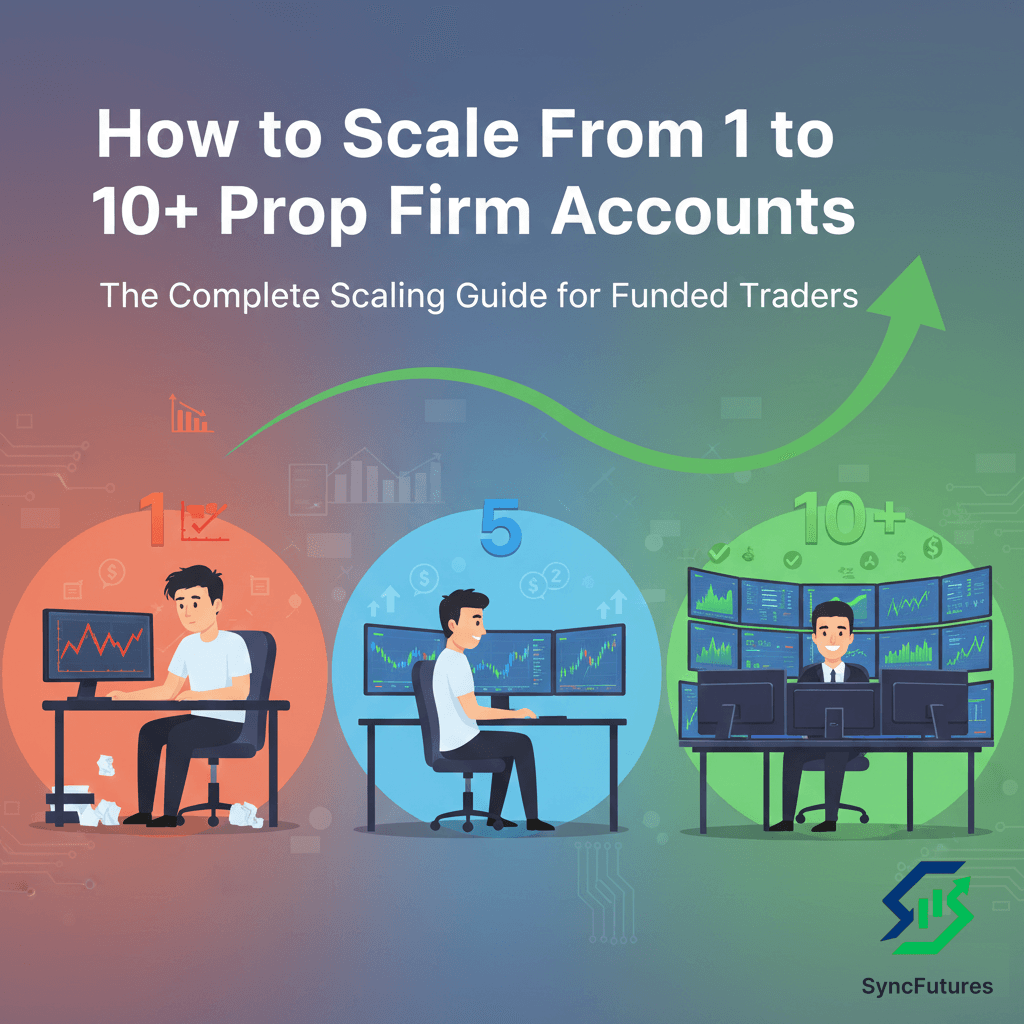
Introduction
You passed your first prop firm challenge. Congrats. Now what?
Here's the reality: One $50k account with a 90% profit split means you need to make $1,111 to earn $1,000. That's your ceiling. No matter how good your trading strategy is, no matter how consistent your edge, one funded account limits your earning potential to whatever that account can generate.
The solution? Strategic scaling to 10+ prop firm accounts.
This isn't about changing your strategy or taking bigger risks. It's about applying the same proven approach across multiple accounts—multiplying your capital access without multiplying your workload. One trader, one strategy, but 10x the buying power.
In this guide, we'll show you exactly how to scale from 1 to 10+ funded accounts systematically—the account limits at major prop firms, the four phases of scaling, the execution challenges you'll face, and the tools that make managing multiple accounts as simple as managing one.
📱 Now available on iOS and Android. Manage broker connections, copy rules, and positions from your phone. See the SyncFutures mobile app →
Why Scale to Multiple Prop Firm Accounts?
The Math of Scaling
Let's start with the obvious reason: income multiplication.
Same strategy, same skill level, same time investment—just more capital:
1 account: $50k × 2% monthly return = $1,000/month (90% split = $900)
5 accounts: $250k × 2% monthly return = $5,000/month (90% split = $4,500)
10 accounts: $500k × 2% monthly return = $10,000/month (90% split = $9,000)
You're not trading differently. You're not working harder. You're simply leveraging more capital with the same edge that got you funded in the first place. The math is straightforward: more accounts = more capital = more income from the same trading decisions.
Risk Diversification
Here's what most traders don't realize until they scale: multiple accounts actually reduce your risk in several important ways.
Independent Drawdown Limits
Each prop firm account has its own drawdown limit. If you're trading one account and you hit a bad streak, one violation blows your entire income source. With ten accounts, a drawdown violation on one account costs you 10% of your capital access, not 100%. You still have nine other accounts generating income while you replace the one that got violated.
Spread Risk Across Multiple Prop Firms
Different prop firms have different rules, different platforms, different risk parameters. Apex Trader Funding calculates drawdown differently than Topstep. Bulenox has different daily loss limits than Take Profit Trader. By spreading your accounts across multiple firms, you're not dependent on any single firm's policies, payout schedules, or platform stability.
If one prop firm changes their rules or experiences technical issues, you still have funded accounts at other firms generating income.
Account-Level Risk Management
With multiple accounts, you can implement sophisticated risk management strategies that aren't possible with a single account. You might trade conservatively on some accounts while being slightly more aggressive on others. You can allocate different strategies to different accounts. You have flexibility that single-account traders simply don't have.
Income Stability
One funded account means one income stream. Ten funded accounts means ten income streams—and that diversification creates stability.
Multiple Payout Schedules
Different prop firms have different payout schedules. Some pay weekly, others bi-weekly, some monthly. When you have accounts across multiple firms, you're receiving payouts more frequently and more consistently. Instead of waiting for one monthly payout, you might receive two or three payouts per month from different firms.
Consistent Monthly Income
A bad trading week on one account doesn't destroy your monthly income when you have nine other accounts still performing. One account might be down 3% while three others are up 4% and six are flat. Your total portfolio smooths out the variance that's inevitable in trading.
Protection Against Platform Issues
Trading platforms go down. Brokers experience outages. Data feeds fail. When you're trading across multiple accounts on different platforms (Tradovate, Rithmic, NinjaTrader), a technical issue on one platform doesn't prevent you from trading entirely. You still have access to your other accounts on other platforms.
The bottom line: scaling to multiple prop firm accounts isn't just about making more money (though that's the primary benefit). It's about building a more resilient, more stable, more professional trading operation.
How Many Accounts Can You Actually Have?
This is the first question every trader asks when considering scaling: "How many accounts will they actually let me have?"
The answer varies by prop firm, and it's changed recently at several firms. Here's what the major prop firms allow as of 2025.
Prop Firm Account Limits (Verified 2025)
| Prop Firm | Max Funded Accounts | Account Sizes Available | Key Notes |
|---|---|---|---|
| Apex Trader Funding | 20 accounts | $25K - $300K | 20 active funded accounts (PAs) per household across all platforms |
| Topstep | 5 accounts | $50K - $150K | 5 Express Funded Accounts maximum; additional passed evaluations go on hold |
| Bulenox | 3 accounts | $25K - $250K | Up to 3 Master accounts; exceeding may result in suspension |
| MyFundedFutures | 10 accounts (5 funded) | $50K - $250K | Max 10 total accounts, with up to 5 sim-funded accounts active simultaneously |
| TakeProfitTrader | 5 accounts | $50K - $150K | Maximum $750K total allocation across 5 PRO/PRO+ accounts combined |
| Tradeify | 5 accounts | $25K - $150K | Maximum 5 total simulated funded accounts combining Growth, Advanced, and Lightning Funded accounts |
Important Clarifications:
Apex Trader Funding: The 20-account limit applies per household, not per individual. This means all accounts connected to the same address, IP address, or household members count toward this limit. The limit applies across both Rithmic and Tradovate platforms combined—not 20 on each platform.
Topstep: If you pass a Trading Combine while you already have 5 active Express Funded Accounts, your additional account will be placed on hold. You have 30 days to pay the activation fee and activate it once you drop below the 5-account maximum.
Bulenox: While some sources mention up to 11 accounts, the official policy states a maximum of 3 Master accounts. Exceeding this limit may result in account disclosure, suspension, or termination.
MyFundedFutures: You can have up to 10 total accounts, but only 5 can be sim-funded and active simultaneously (specifically for $50K accounts). Failed evaluation accounts don't count toward your limit.
TakeProfitTrader: The 5-account limit applies to funded PRO and PRO+ accounts combined, not each. During the evaluation phase, you can have unlimited accounts. Each account is capped at $150K, with a total maximum allocation of $750K across all funded accounts.
Tradeify: Maximum of 5 total simulated funded accounts with any combination of Growth, Advanced, and Lightning Funded account types. Each account is treated independently for withdrawals. The Lightning Funded accounts uniquely offer a $25K entry-level option.
The Universal Rule Across All Prop Firms
While account limits vary, one rule is consistent across virtually every prop firm:
You must be the only trader on your accounts, using your own strategy.
This means:
- ✅ You can have multiple accounts as long as YOU are trading them
- ✅ You can use trade copiers to replicate YOUR trades across YOUR accounts
- ✅ You can use the same strategy across all your accounts
- ❌ You cannot copy trades from someone else (signal services, shared strategies, etc.)
- ❌ You cannot have someone else trade your funded accounts
- ❌ You cannot share login credentials with other traders
Most prop firms explicitly allow trade copiers and automated execution tools—they view these as professional scaling tools, not prohibited automation. The key distinction is that YOU must be making every trading decision. The copier is simply replicating your manual decisions across multiple accounts.
Always verify current rules with your specific prop firm. Account limits and policies can change. Before purchasing additional evaluations or connecting accounts to a trade copier, check the firm's current terms of service or contact their support team to confirm their policies.
What This Means for Your Scaling Strategy
The account limits create a natural ceiling for each prop firm:
- Apex traders can scale to 20 accounts ($600K - $6M total capital depending on account sizes)
- Topstep traders can scale to 5 accounts ($250K - $750K total capital)
- Bulenox traders can scale to 3 accounts ($75K - $750K total capital)
- MyFundedFutures traders can scale to 5-10 accounts ($250K - $2.5M total capital)
- TakeProfitTrader traders can scale to 5 accounts (maximum $750K total allocation)
- Tradeify traders can scale to 5 accounts ($125K - $750K total capital)
The multi-firm approach: Many professional prop traders combine firms. You might have 20 Apex accounts, 5 Topstep accounts, 5 Tradeify accounts, and 3 Bulenox accounts—giving you access to 33 funded accounts and several million dollars in total buying power. As long as you're following each firm's individual rules, there's no restriction on trading with multiple prop firms simultaneously.
The 4 Phases of Scaling
Scaling from 1 to 10+ funded accounts isn't something you do overnight. Traders who rush the process—passing one challenge and immediately buying ten more—almost always fail. They haven't proven consistency, they don't have the systems in place, and they can't handle the execution complexity.
The successful approach is methodical. Here are the four phases of scaling, with specific timelines and goals for each.
Phase 1: Master One Account (Months 1-3)
Goal: Prove consistent profitability with a single funded account.
This is your foundation. Before you even think about scaling, you need to demonstrate—to yourself and to the prop firm—that you can be consistently profitable over time.
What to do:
- Pass your first evaluation using your proven strategy
- Get funded and start trading the live funded account
- Trade for a minimum of 3 months (not 3 weeks, not 1 month—a full quarter)
- Hit consistent 2-5% monthly returns (you're not trying to get rich; you're proving consistency)
- Understand the firm's rules inside and out (drawdown calculations, daily loss limits, prohibited trading practices)
- Document your strategy in detail so you can replicate it exactly on additional accounts
Why wait 3 months?
One profitable week doesn't mean you have an edge. One profitable month doesn't mean you have an edge. Three consecutive months of consistent returns? That's when you can be confident you're actually profitable, not just lucky.
This phase also teaches you the prop firm's platform, their execution speed, their margin requirements, and their rule enforcement. You'll learn what works and what doesn't—lessons that will be invaluable when you're managing multiple accounts.
Red flags that you're not ready to scale yet:
- You haven't been profitable for at least 3 months
- Your returns are wildly inconsistent (up 15% one month, down 8% the next)
- You've violated a rule (even if the account wasn't terminated)
- You can't clearly articulate your trading strategy and why it works
- You're still "figuring things out" with your approach
Don't scale until you've mastered one account. The problems you have with one account will multiply when you have ten.
Phase 2: Add 2-3 More Accounts (Months 4-6)
Goal: Test your ability to manage multiple accounts simultaneously.
After proving consistency with one account, it's time to test scalability. Can you execute the same strategy across multiple accounts effectively?
What to do:
- Purchase 2-3 more evaluations (same firm or different firms—your choice)
- Pass evaluations using the EXACT same strategy that worked on your first account
- Get funded and start managing 3-4 funded accounts simultaneously
- Maintain the same consistency you demonstrated in Phase 1
- Identify execution bottlenecks (we'll address these in Phase 3)
The reality check:
This is where most traders discover that manual trade copying doesn't scale well. You'll experience:
-
Execution delays: You execute on account 1, then account 2, then account 3. By the time you're entering on account 4, the market has moved 2-3 ticks. You're getting inconsistent fills purely due to execution speed, not trading decisions.
-
Mental fatigue: Clicking the same buttons 3-4 times per trade is exhausting. You spend more time on execution logistics than on reading the market.
-
Position sizing errors: Account 1 has $50K, account 2 has $100K, account 3 has $150K. You need to trade different quantities on each, and doing mental math mid-trade is when mistakes happen.
These problems are normal. Experiencing them doesn't mean you're not ready to scale—it means you're ready to systematize your approach in Phase 3.
Success metrics for Phase 2:
- ✅ You passed 2-3 additional evaluations using your proven strategy
- ✅ You're managing 3-4 funded accounts without violating rules
- ✅ Your returns per account are similar to Phase 1 (proving your strategy scales)
- ✅ You've identified exactly where manual execution is slowing you down
If you struggle in this phase:
Don't add more accounts yet. Figure out why you're struggling:
- Is your strategy not as systematic as you thought?
- Are you making execution mistakes due to rushing?
- Are you over-leveraging because you have more capital?
- Are you violating risk management rules?
Fix the problems with 3-4 accounts before scaling to 10.
Phase 3: Scale to 6-10 Accounts (Months 7-12)
Goal: Systematize your operations and automate execution.
This is the phase where professional prop traders separate themselves from amateurs. You can't manually copy trades across 10 accounts effectively. The execution delays, the mental fatigue, the increased probability of errors—it doesn't work.
Critical decision point: You MUST automate trade execution at this phase.
Why manual copying fails beyond 5 accounts:
-
Time: Executing on 10 accounts takes 10x longer than executing on one account. By the time you've entered account 7-8, the market has moved significantly from where you entered accounts 1-2.
-
Inconsistency: You meant to enter 2 contracts on each account, but you accidentally entered 3 on account 5 and 1 on account 8. Now you have inconsistent position sizes across your portfolio.
-
Mental bandwidth: You're spending 90% of your mental energy on execution logistics and only 10% on actually reading the market and identifying quality setups. Your trading performance degrades because you can't focus on what matters.
-
Error probability: Every manual execution is an opportunity for mistakes. With 10 accounts and multiple trades per day, you're making hundreds of individual executions per week. The probability of a fat-finger error or forgotten stop loss approaches certainty.
What you need in Phase 3:
-
Trade copier software that automatically replicates trades from one master account to all follower accounts in real-time (more on this in the next section)
-
Position sizing system that automatically calculates correct contract quantities for each account based on its size
-
Risk management automation that copies stop losses, profit targets, and exit decisions to all accounts simultaneously
-
Performance tracking for each individual account (not just total P&L)
How to scale in Phase 3:
-
Implement a trade copier (we recommend cloud-based solutions like SyncFutures that require no VPS or software installation)
-
Test thoroughly with demo accounts first to verify trade replication works correctly
-
Add 2-3 more funded accounts (bringing your total to 6-7)
-
Verify automated execution is working reliably with sub-second replication
-
Scale to 8-10 accounts over the next 2-3 months as you gain confidence in the automated system
Success metrics for Phase 3:
- ✅ You're managing 8-10 funded accounts with automated trade copying
- ✅ Execution happens within 1-2 seconds across all accounts (not 30-60 seconds)
- ✅ Position sizing is consistent and automatic across all accounts
- ✅ You spend your time analyzing markets, not clicking order tickets
- ✅ Your per-account returns remain consistent with Phase 1-2
At the end of Phase 3, you should have 8-10 funded accounts running efficiently with minimal additional effort compared to managing a single account.
Phase 4: Optimize 10+ Accounts (Month 12+)
Goal: Maximize efficiency, income, and consistency across your entire portfolio.
You've proven consistency (Phase 1), tested scalability (Phase 2), systematized operations (Phase 3). Now it's time to optimize.
What to focus on in Phase 4:
1. Fine-tune position sizing
Not all accounts need the same multiplier forever. As accounts grow or shrink based on trading performance, adjust your position size multipliers to keep risk consistent:
- Review account balances monthly
- Recalculate appropriate position sizes based on current buying power
- Update multipliers in your trade copier settings
- Test with a small trade to verify new sizing works correctly
2. Optimize which accounts to keep active
Not every prop firm or account size is optimal for your strategy. After several months of trading across multiple firms, you'll notice patterns:
- Some firms have faster execution than others
- Some account sizes work better with your strategy than others
- Some platforms have better data feeds or more reliable infrastructure
Focus your efforts on the accounts and firms that work best for your specific approach. It's better to have 8 highly optimized accounts than 15 accounts where half are underperforming.
3. Focus on highest-probability setups
When you're managing significant capital across 10+ accounts, you don't need to force trades. You can afford to be selective and wait for only your absolute best setups.
Many traders report that their win rate actually improves in Phase 4 because they're no longer over-trading. They have enough capital that a few high-quality trades per day or per week is sufficient.
4. Maintain strict risk management
The biggest risk in Phase 4 is complacency. You've been profitable for a year. You have 10+ accounts. You're making consistent income. It's tempting to relax your risk management rules.
Don't.
Continue following the same risk parameters that got you here:
- Never risk more than 1-2% per account per trade
- Set maximum daily loss limits across ALL accounts combined
- Have an emergency "flatten all" button to close every position if needed
- Track combined drawdown across all accounts, not just individual account levels
Success metrics for Phase 4:
- ✅ You have 10+ funded accounts running efficiently
- ✅ Position sizing is optimized for each account's current balance
- ✅ You've removed or replaced underperforming accounts
- ✅ You maintain consistent returns while trading only your best setups
- ✅ Risk management is systematic and strictly enforced
The reality of Phase 4:
At this stage, you're running a professional trading operation. You have access to hundreds of thousands or millions of dollars in capital. You're generating significant monthly income from the same strategy that started with one $50K account.
The difference isn't that you became a better trader—it's that you built better systems.
Common Mistakes When Scaling
Scaling to 10+ funded accounts sounds simple in theory: pass evaluations, get funded, use a trade copier. In practice, traders make predictable mistakes that cost them thousands in lost profits and blown accounts.
Here are the five most common scaling mistakes—and how to avoid them.
Mistake #1: Scaling Too Fast
The problem: You pass your first challenge. You're excited. You immediately purchase 10 more evaluations, pass them all within a month, and suddenly you're managing 10 funded accounts in month two.
Why it fails:
You haven't proven consistency yet. One profitable month doesn't mean you have an edge—it might mean you got lucky. You don't know if your strategy actually scales across multiple accounts. You can't handle the execution complexity of 10 accounts because you barely have experience with one. And worst of all, if your "edge" was actually just luck, you're about to blow 10 funded accounts simultaneously instead of one.
Real scenario:
A trader passes an Apex $50K evaluation in week three. Confident in his strategy, he immediately purchases 9 more evaluations. He passes all nine within the next month. By month two, he has 10 funded Apex accounts.
His first month trading all 10 accounts: up 4% across the board. He's ecstatic—$20K in total profit, $18K in payouts.
His second month: down 6% across the board. He violated drawdown limits on 7 of his 10 accounts. Those accounts are terminated. He lost $3,500 in evaluation fees plus all future income from those accounts.
The problem wasn't his strategy—it was that he scaled before proving consistency and before understanding how to manage risk across multiple accounts.
The solution:
Follow the 4-phase approach outlined above. Prove consistency for 3 months with one account. Add 2-3 accounts and test for another 2-3 months. Only then scale to 6-10 accounts. Gradual scaling gives you time to learn, adapt, and build the systems you need before managing significant capital.
For more on avoiding early mistakes, see our guide on common mistakes that cause traders to fail prop firm challenges.
Mistake #2: Manual Trade Copying Beyond 3 Accounts
The problem: You're trying to manually copy trades across 5, 7, or even 10 accounts. You spot a perfect setup, execute on account 1, switch to account 2, execute, switch to account 3...
Real scenario:
You see a perfect ES setup at 4525.00. Clean level, strong confluence, exactly what your strategy is designed to trade.
You execute on account 1: filled at 4525.00.
You switch platforms, execute on account 2: filled at 4525.25.
Switch to account 3: filled at 4525.50.
Account 4: filled at 4525.75.
Account 5: filled at 4526.00.
By the time you get to accounts 6-7, ES is at 4527.00. You're down 2 full points (8 ticks) on half your accounts before the trade even starts developing. Accounts 8-10 don't even get filled because the market has moved beyond your acceptable entry range.
You entered one trade. But across 10 accounts, you have 10 completely different fills, 10 different risk/reward ratios, and 3 accounts that missed the entry entirely.
Why it fails:
Markets move fast. Futures contracts can move multiple ticks in seconds. By the time you've manually entered trades on 5-7 accounts, the entry price is significantly different. You can't execute fast enough to get consistent fills across all accounts.
The solution:
Automate execution with a trade copier after 3-4 accounts. A professional trade copier replicates trades across all accounts in milliseconds—not minutes. You execute once on your master account, and all follower accounts receive the same order simultaneously. Everyone gets filled at nearly identical prices, maintaining the risk/reward ratio your strategy is designed for.
Mistake #3: Inconsistent Position Sizing
The problem: You're trading different position sizes across accounts, but you're calculating them manually—and you're making mistakes.
Real scenario:
You have five accounts:
- Apex $50K account
- Apex $100K account
- Apex $150K account
- Topstep $100K account
- Bulenox $150K account
Your strategy calls for risking 1% per trade. On a trade with a 10-tick stop loss on ES (each tick = $12.50):
- $50K account: 1% risk = $500 / ($12.50 × 10) = 4 contracts
- $100K account: 1% risk = $1,000 / ($12.50 × 10) = 8 contracts
- $150K account: 1% risk = $1,500 / ($12.50 × 10) = 12 contracts
But you're doing this mental math in the middle of a fast market. You meant to trade 4 contracts on the $50K account but accidentally entered 6. Now you're risking 1.5% instead of 1%—and if this trade goes against you, you're much closer to violating the daily loss limit than you intended.
Why it matters:
Inconsistent position sizing destroys your risk management system. You think you're risking 1% per trade, but in reality, you're risking anywhere from 0.8% to 1.8% depending on whether you calculated correctly. Some accounts are over-leveraged, some are under-leveraged. You can't accurately track performance because every account is trading slightly different risk parameters.
The solution:
Use automated position sizing that scales based on account size. Modern trade copiers like SyncFutures let you set multipliers for each follower account. You configure it once:
- Account 1 (master): 1x multiplier
- Account 2 ($50K): 0.5x multiplier
- Account 3 ($100K): 1x multiplier
- Account 4 ($150K): 1.5x multiplier
You trade 8 contracts on the master account, and the copier automatically calculates:
- Account 2: 4 contracts (8 × 0.5)
- Account 3: 8 contracts (8 × 1.0)
- Account 4: 12 contracts (8 × 1.5)
You never think about position sizing again. It's calculated and executed correctly on every trade, automatically.
Mistake #4: Ignoring Individual Account Rules
The problem: You're treating all 10 accounts the same, even though they're with different prop firms that have different rules.
Reality check:
- Apex Trader Funding uses an "end-of-day" drawdown calculation
- Topstep uses a "trailing" drawdown calculation
- Bulenox has a 4% daily loss limit
- MyFundedFutures has different margin requirements than Take Profit Trader
If you don't understand these differences, you might violate a rule on one account while staying well within limits on another—even though you're trading the exact same strategy.
Real scenario:
You have three funded accounts: Apex $150K, Topstep $100K, Bulenox $100K.
You have a bad trading day and you're down $3,000 across the board on all accounts:
-
Apex account: Down $3,000 = 2% daily loss. Well within the $4,500 daily loss limit (3% of $150K). Account is fine.
-
Topstep account: Down $3,000 = 3% daily loss. You're getting close to the $2,500 daily loss limit (2.5% of $100K). One more losing trade might violate the rule.
-
Bulenox account: Down $3,000 = 3% daily loss. You've already violated the 4% daily loss limit at $4,000. But you didn't realize Bulenox calculates losses differently—and now the account is under review.
Same trading, same positions, same P&L—but one account violated rules while the others didn't.
The solution:
Track rules per firm in a spreadsheet or document:
| Account | Prop Firm | Daily Loss Limit | Max Drawdown | News Trading | Position Limits |
|---|---|---|---|---|---|
| Account 1 | Apex | $4,500 | $9,000 | Allowed | 20 contracts |
| Account 2 | Topstep | $2,500 | $5,000 | Restricted | 15 contracts |
| Account 3 | Bulenox | $4,000 | $10,000 | Allowed | 10 contracts |
Before you trade each day, know exactly what the limits are for each account. If one account is approaching its daily loss limit, you might need to manually disable copying for that specific account while continuing to trade on your other accounts.
Mistake #5: Not Tracking Performance Per Account
The problem: You're only looking at total P&L across all accounts. "I made $5,000 this week" sounds great—but you have no idea which accounts are actually profitable and which are underperforming.
Real scenario:
Total P&L across 10 accounts for the month: +$12,000. Looks fantastic.
But when you break it down per account:
- Accounts 1-3 (Apex on Tradovate): +$8,000 combined
- Accounts 4-6 (Topstep on Rithmic): +$6,000 combined
- Accounts 7-8 (Bulenox on Rithmic): -$1,000 combined
- Accounts 9-10 (MyFundedFutures on NinjaTrader): -$1,000 combined
Your Apex accounts are crushing it. Your Topstep accounts are doing well. But your Bulenox and MyFundedFutures accounts are losing money.
Why this matters:
You're paying monthly fees or account maintenance costs for accounts that are losing money. You might be better off closing the underperforming accounts and focusing on the firms and platforms that work best for your strategy. But you'll never know this if you only track total P&L.
The solution:
Review performance per account daily or weekly:
- Track P&L for each individual account
- Calculate win rate, average win, average loss per account
- Identify which prop firms work best for your strategy
- Identify which platforms have the best execution quality for your approach
- Remove or replace consistently underperforming accounts
Professional prop traders don't just track "how much did I make this month"—they track "which accounts are actually contributing to my profitability, and which are dead weight?"
The Execution Problem: Why You Need a Trade Copier
There's a breaking point every trader hits when scaling to multiple accounts. For most, it happens around 4-5 funded accounts.
Up to 3 accounts, manual execution is painful but manageable. By account 4-5, you're spending more time clicking order tickets than actually trading. By account 6-7, consistent execution becomes nearly impossible.
This is the execution problem—and it's why virtually every professional prop trader who scales beyond 5 accounts uses a trade copier.
The Breaking Point: 4-5 Accounts
Research and real trader experiences show that beyond 3-4 accounts, manual execution becomes:
Time-consuming: Executing the same trade across 5 accounts takes 25-30 seconds if you're fast. Across 10 accounts? You're looking at 60+ seconds per entry. If you trade 10 times per day, that's 10+ minutes spent purely on clicking buttons—time the market doesn't give you.
Error-prone: Every manual execution is an opportunity for mistakes. Wrong quantity, wrong direction, forgotten stop loss, fat-finger on the price. With one account, you might make one mistake per week. With 10 accounts and dozens of trades, you're making mistakes daily.
Inconsistent: By the time you've entered on accounts 5-6, the market has moved from where you entered on accounts 1-2. You're getting completely different fills across your accounts purely due to execution speed, not trading decisions.
Mentally exhausting: You're context-switching between 10 different trading platforms, 10 different order tickets, 10 different position displays. Every switch drains mental energy. By the third hour of trading, you're not thinking about your next setup—you're thinking about whether you remembered to set a stop loss on account 7.
This isn't sustainable. And it's not how professional traders operate.
For a full breakdown of exactly what manual execution costs traders scaling past 5 accounts — time, slippage, fat-fingers, and missed trades — see The Hidden Cost of Manual Trade Copying.
What is a Trade Copier?
A trade copier is software that automatically replicates trades from one master account to multiple follower accounts in real-time.
How it works:
-
You designate one account as your master — This is the account where you trade manually, exactly like you always have.
-
All other accounts become followers — These accounts automatically copy everything that happens on the master.
-
Real-time replication — The trade copier monitors your master account. When you enter a trade, modify a stop loss, or exit a position, the copier instantly replicates that action to all follower accounts.
From your perspective, nothing changes about how you trade. You still make every decision manually. You still read the market, identify setups, and execute trades on your master account. The copier handles the mechanical task of replicating those decisions across your other accounts.
What you do: Execute one trade on the master account.
What the trade copier does: Replicates that trade across 5, 10, or 20 follower accounts in milliseconds.
For a complete breakdown of how this works, see our detailed guide on how to copy trades across multiple prop firm accounts.
Benefits of Trade Copying for Prop Firm Scaling
Execute Once, Replicate Everywhere
You make one trading decision. You execute once on the master account. The copier handles the rest. Within milliseconds, that same trade appears on all 10 follower accounts with identical parameters. No clicking, no delays, no manual work.
Sub-Second Synchronization
Modern cloud-based trade copiers like SyncFutures replicate trades in milliseconds. Your follower accounts receive and execute orders almost simultaneously with your master account. The result? Minimal slippage between accounts and consistent fills across your entire portfolio.
When you enter ES at 4525.00 on the master:
- Account 2: filled at 4525.00
- Account 3: filled at 4525.25
- Account 4: filled at 4525.00
- Accounts 5-10: filled between 4525.00 and 4525.25
Everyone gets nearly the same fill. Same risk/reward ratio. Same trade quality.
Consistent Position Sizing
The trade copier handles position sizing automatically. You set multipliers for each follower account based on its size:
- Your master trades 2 contracts
- Your $50K account automatically trades 1 contract (0.5x multiplier)
- Your $150K account automatically trades 2 contracts (1x multiplier)
- Your $250K account automatically trades 4 contracts (2x multiplier)
You never calculate position sizes manually again. The copier calculates and executes the correct quantity for each account on every trade, automatically.
Comprehensive Risk Management
Stop losses copy automatically. Profit targets copy automatically. If you manually flatten your position on the master account because you're reading the market wrong, all follower accounts flatten simultaneously. Your risk management applies uniformly across all accounts without any extra effort.
More Time to Focus on Strategy
This might be the most valuable benefit: mental bandwidth.
When you're not frantically clicking between 10 platforms, you can focus entirely on what actually makes you money—reading the market, finding quality setups, and managing your positions.
Many traders report that their actual trading performance improves after implementing trade copying, simply because they have more mental energy for analysis instead of execution logistics.
When to Get a Trade Copier
Here's the simple answer:
- 4+ funded accounts: Highly recommended
- 6+ accounts: Essential
- 10+ accounts: Impossible to scale effectively without one
You can manually copy across 2-3 accounts if you're determined. It's painful, but it's technically doable. Beyond that, you're fighting a losing battle against time, mental fatigue, and execution delays.
The question isn't "should I get a trade copier?"—it's "how soon can I implement one so I stop wasting time and mental energy on manual execution?"
Brief Mention: How SyncFutures Solves This
Tools like SyncFutures enable prop traders to manage 10, 20, or even 50 accounts with the same effort as managing one. The platform handles execution automatically while you focus on finding trades.
Key features for prop firm scaling:
- 100% cloud-based: No VPS required, no software to download
- Millisecond synchronization: Sub-second replication across all accounts
- Tradovate, Rithmic & NinjaTrader support: Works with all major prop firm platforms
- Automatic position sizing: Set multipliers once, never think about it again
- Built-in risk management: One-click emergency flatten across all accounts
For detailed setup instructions, check our platform-specific guides:
The bottom line: professional prop traders who scale to 10+ accounts don't do it manually. They systematize execution with trade copiers and spend their time on what actually matters—trading.
Step-by-Step Scaling Checklist
Scaling to 10+ funded accounts is a 12+ month process. Here's your complete checklist for each phase, with specific actions to take at each stage.
Month 1-3: Foundation
☐ Pass your first prop firm evaluation
- Choose one prop firm to start (Apex, Topstep, Bulenox, etc.)
- Pass the evaluation using your proven strategy
- Don't rush—focus on following rules and demonstrating consistency
☐ Get funded
- Activate your first funded account
- Understand the funded account rules (they may differ from evaluation rules)
- Set up your trading platform and risk management tools
☐ Trade consistently for 3 months
- Trade your funded account following the exact same strategy you used in evaluation
- Don't change your approach just because you're funded
- Focus on consistency over large gains
☐ Achieve 2-5% monthly returns
- You're not trying to make 20% per month—you're proving consistency
- 2-5% monthly is sustainable and demonstrates edge
- Higher returns are great, but consistency matters more than size
☐ Document your strategy
- Write down your exact entry criteria
- Document your risk management rules (stop loss placement, position sizing)
- Record your exit strategy (profit targets, trailing stops, manual exits)
- You'll need this documentation to replicate your approach on additional accounts
☐ Track every trade in a journal
- Entry price, exit price, position size, P&L
- Why you took the trade (setup, confluence factors)
- Emotional state (calm, rushed, frustrated, confident)
- Lessons learned from each trade
Success criteria before moving to Phase 2:
- ✅ 3 consecutive profitable months
- ✅ No rule violations
- ✅ Clear documentation of your strategy
- ✅ Confidence that your edge is real, not luck
Month 4-6: Initial Scaling
☐ Purchase 2-3 more evaluations
- Same prop firm or different firms—your choice
- Use the same account sizes you're comfortable with
- Don't buy 10 evaluations yet—start with 2-3
☐ Pass additional challenges
- Use the EXACT same strategy that worked on your first account
- If you can't pass with the same strategy, don't scale yet
- Passing proves your strategy is systematic and repeatable
☐ Test manual execution with 3-4 accounts
- Trade all accounts simultaneously using manual trade copying
- Experience the pain points of manual execution
- Identify exactly where the bottlenecks are
☐ Create position sizing spreadsheet
- Document each account's size and appropriate position sizing
- Calculate risk per trade for each account
- Keep this updated as account balances change
☐ Identify execution bottlenecks
- How long does it take to enter across all accounts?
- Are you getting inconsistent fills?
- Are you making position sizing errors?
- What's the most frustrating part of managing multiple accounts?
Success criteria before moving to Phase 3:
- ✅ Passed 2-3 additional evaluations
- ✅ Managing 3-4 funded accounts profitably
- ✅ Identified execution challenges with manual copying
- ✅ Maintained similar returns to Phase 1
Month 7-9: Systematization
☐ Implement trade copier solution
- Research trade copiers that support your prop firm platforms
- Choose between local software (VPS required) or cloud-based (like SyncFutures)
- Sign up and complete initial setup
☐ Test automation with demo accounts first
- Connect demo accounts to the trade copier
- Set up copy rules (master/follower designation, position size multipliers)
- Place test trades and verify replication works correctly
- Test stop loss copying, partial exits, and full position flattening
- Verify emergency "flatten all" button works
☐ Scale to 6-8 funded accounts
- Pass 3-4 more evaluations
- Get funded and connect to your trade copier
- Start with real trades using the automated system
☐ Create daily review process
- Check all account connection statuses
- Verify positions are synchronized across all accounts
- Review P&L per account (not just total)
- Monitor how close each account is to daily loss limits
☐ Build performance tracking system
- Spreadsheet or software that tracks each account individually
- Daily P&L, weekly P&L, monthly P&L per account
- Track which prop firms/platforms perform best for your strategy
Success criteria before moving to Phase 4:
- ✅ Trade copier is working reliably with sub-second replication
- ✅ Managing 6-8 funded accounts with automated execution
- ✅ Spending more time analyzing markets than clicking order tickets
- ✅ Maintaining consistent per-account returns
Month 10-12: Optimization
☐ Scale to 10+ accounts if profitable
- Only scale if you're consistently profitable with 6-8 accounts
- Pass additional evaluations to reach 10+ total funded accounts
- Connect new accounts to your trade copier system
☐ Optimize position sizing across accounts
- Review each account's current balance
- Recalculate appropriate multipliers based on account sizes
- Update trade copier settings with new multipliers
- Test with small trades to verify new sizing
☐ Remove underperforming accounts
- Identify accounts that are consistently losing money
- Determine if it's the prop firm, platform, or account size that's the issue
- Close or replace accounts that don't fit your strategy
☐ Focus on highest-probability setups
- You have significant capital now—you don't need to force trades
- Be selective and wait for only your absolute best setups
- Quality over quantity
☐ Maintain strict risk management
- Never risk more than 1-2% per account per trade
- Set maximum daily loss across ALL accounts combined
- Use emergency position flattening if needed
- Track combined drawdown, not just individual account levels
Success criteria for Phase 4:
- ✅ Managing 10+ funded accounts efficiently
- ✅ Consistent monthly returns across your account portfolio
- ✅ Systems in place for monitoring, execution, and risk management
- ✅ Spending minimal time on execution, maximum time on trading decisions
Best Practices for Managing Multiple Accounts
You've scaled to 10+ accounts. You have automated execution. You're generating consistent income. Now it's about maintaining that success long-term.
Here are the best practices professional prop traders use to manage large portfolios of funded accounts.
1. Use Account Groups
Don't treat all 10 accounts as one undifferentiated mass. Organize them into logical groups.
Group by prop firm:
- All Apex accounts together
- All Topstep accounts together
- All Bulenox accounts together
This makes it easy to track performance per firm and identify which firms work best for your strategy.
Group by account size:
- $50K accounts in one group
- $100K accounts in another group
- $150K+ accounts in a third group
Different account sizes might require different position sizing approaches or risk management rules.
Group by risk level:
- Conservative accounts (lower position sizes, tighter stops)
- Standard accounts (your normal strategy)
- Aggressive accounts (slightly larger positions on highest-probability setups)
This gives you flexibility to adjust risk across your portfolio without changing your overall approach.
2. Daily Review Routine
Before you start trading each day, complete this checklist:
☐ Check drawdown levels on all accounts
- How much room do you have before hitting daily loss limits?
- Are any accounts close to max drawdown limits?
- Do you need to reduce position sizes or disable copying on any accounts today?
☐ Review overnight positions
- Are they still valid setups, or should they be closed?
- Are all accounts showing the same positions?
☐ Verify no rule violations
- Check for any emails or notifications from prop firms
- Verify all accounts are in good standing
- Confirm no unexpected account closures or restrictions
☐ Check for platform issues
- Are all trading platforms online and functioning?
- Are data feeds working correctly?
- Is your trade copier showing all accounts as "Connected"?
This takes 3-5 minutes per day and prevents 95% of account-blowing mistakes.
3. Weekly Performance Analysis
At the end of each week, review:
☐ Compare account performance
- Which accounts were most profitable this week?
- Which accounts lost money?
- Are there patterns (specific firms, platforms, account sizes)?
☐ Identify best/worst performers
- Is one prop firm consistently outperforming others?
- Is one platform giving you better execution than others?
- Are larger accounts performing better or worse than smaller accounts?
☐ Adjust position sizing if needed
- Have any account balances changed significantly?
- Do multipliers need to be updated?
- Should you reduce position sizes on accounts approaching drawdown limits?
☐ Plan upcoming week's strategy
- What's the market outlook for next week?
- Are there any high-impact news events to be aware of?
- Will you need to reduce risk or avoid trading during specific times?
4. Risk Management Rules
These rules are non-negotiable when managing multiple funded accounts:
Never risk more than 1-2% per account per trade
Just because you have 10 accounts doesn't mean you should risk more. If you normally risk 1% per account, maintain that 1% risk across all accounts. Don't increase it to 3% just because you have more capital.
Set maximum daily loss across ALL accounts
Example: If each account has a $2,000 maximum loss limit (total drawdown), and you have 10 accounts, your theoretical maximum combined loss is $20,000. Don't get anywhere close to that.
Set a personal daily loss limit across all accounts combined—perhaps $5,000 or $8,000. When you hit that limit, stop trading for the day across all accounts.
Have a "kill switch" to flatten everything if needed
Markets can move violently. Flash crashes happen. If you need to exit every position immediately, you should be able to do it with one click—not by manually closing 10 different accounts.
Your trade copier should have an emergency "Flatten All Positions" button that closes every position across every account in seconds.
Track combined drawdown across all accounts
Don't just monitor individual account drawdowns. Track your total drawdown across all accounts combined. If you're down 5% across your entire portfolio, that's a warning sign—even if no individual account has violated its rules yet.
5. Maintain Separate Trading Journal
Even with 10 accounts, you should document:
For each trade:
- Entry and exit prices
- Position size (on master account)
- Rationale for the trade (why you took it)
- Market context (trend, support/resistance levels, confluence factors)
- Emotional state when entering (calm, rushed, frustrated, confident)
- Outcome and lessons learned
Weekly summaries:
- Total trades taken
- Win rate
- Average win vs. average loss
- Best trade of the week and why it worked
- Worst trade of the week and what you learned
Journaling isn't just for beginners. Professional traders with years of experience still journal because it's the only way to identify patterns in your performance and continuously improve.
Real Example: Scaling Timeline
Let's look at a realistic example of how a trader might scale from 1 to 10 funded accounts over 12 months.
Month 1-2: Passed Apex $50K evaluation, got funded
- Started with one funded account
- Focused on consistency and learning Apex's rules
- Averaged 3% monthly returns
Month 3-4: Consistent returns, purchased 2 more Apex evaluations
- Proved consistency over 3 months with first account
- Passed both additional evaluations
- Got funded, now managing 3 accounts ($150K total capital)
Month 5: Tested manual trade copying across 3 accounts
- Experienced execution delays (20-30 seconds to enter across all 3 accounts)
- Made position sizing errors twice
- Realized manual copying wouldn't scale beyond 4-5 accounts
Month 6: Implemented trade copier, added 1 more account
- Set up SyncFutures cloud-based trade copier
- Tested with demo accounts first
- Connected 4 funded accounts and verified automated execution
- Replication time reduced to under 1 second
Month 7-8: Added 2 Topstep accounts
- Passed two Topstep $100K evaluations
- Now managing 6 total accounts: 4 Apex, 2 Topstep ($400K total capital)
- Maintained consistent performance with automated execution
Month 9-10: Scaled to 10 accounts total
- Passed 4 more evaluations (2 Apex, 2 Topstep)
- Now managing 10 accounts: 6 Apex $50K, 4 Topstep $100K ($700K total capital)
- Execution complexity didn't increase—still trading one master account
Month 11-12: Optimized to best 8 performing accounts
- Removed 2 underperforming Apex accounts
- Focused on highest-performing accounts and platforms
- Maintained 8 accounts: 4 Apex $50K, 4 Topstep $100K ($600K total capital)
- Averaged 4% monthly return across the portfolio
Result:
$600K total capital × 4% average monthly return = $24,000/month gross profit
With 90% profit split: $21,600/month in payouts
From start to finish: 12 months
The trader didn't get rich overnight. They proved consistency, scaled gradually, implemented the right systems, and built a sustainable trading operation that generates professional-level income.
Conclusion
Scaling from 1 to 10+ prop firm accounts isn't about changing how you trade. It's about building systems that allow you to apply the same proven strategy across more capital without increasing your workload.
The key takeaways:
-
Scale gradually over 12+ months: Prove consistency with one account before adding more. Rush the process, and you'll blow multiple accounts simultaneously.
-
Prove consistency before adding accounts: Three months of profitable trading is the minimum. One good month isn't enough to confirm you have a real edge.
-
Automate execution after 4-5 accounts: Manual trade copying doesn't scale. Beyond 4-5 accounts, execution delays and errors make consistent performance nearly impossible.
-
Track performance religiously: Monitor each account individually, not just total P&L. Identify which firms and platforms work best for your strategy.
-
Maintain strict risk management: More accounts = more capital, but your risk per trade should stay the same. Don't over-leverage just because you have 10 accounts instead of one.
The difference between earning $1,000/month and $10,000/month isn't trading skill—it's capital access and execution systems.
You already have the skill (you passed your first evaluation). You have access to more capital (prop firms allow multiple accounts). The only missing piece is systematizing your execution so you can trade 10 accounts as easily as you trade one.
What is Prop Firm Trading?
If you're new to prop firm trading and want to understand the fundamentals before scaling, read our comprehensive guide on what is prop firm trading.
Ready to scale beyond manual copying?
SyncFutures helps prop firm traders manage unlimited accounts with automated trade copying, consistent position sizing, and sub-second execution.
What you get:
- ✅ 100% cloud-based (no VPS, no downloads)
- ✅ Millisecond trade replication across all accounts
- ✅ Automatic position sizing based on account size
- ✅ Emergency position flattening
- ✅ Real-time Control Room dashboard to monitor all accounts
- ✅ Support for Tradovate, Rithmic & NinjaTrader
Start your 7-day free trial and see how professional prop traders scale to 10, 20, or 50 accounts with the same effort as managing one.
Want to learn more about our platform first? Check out all our features or read our detailed integration guides for Tradovate and Rithmic.
Your trading strategy earned you those funded accounts. Now let SyncFutures help you scale that strategy across all of them—efficiently, reliably, and automatically.