

The Hidden Cost of Manual Trade Copying (And How to Estimate Yours)
Manual trade copying across multiple prop firm accounts has real costs beyond the obvious ones — time, execution slippage, entry errors, and missed setups. Here's how to think about each one and estimate what it's actually costing you.
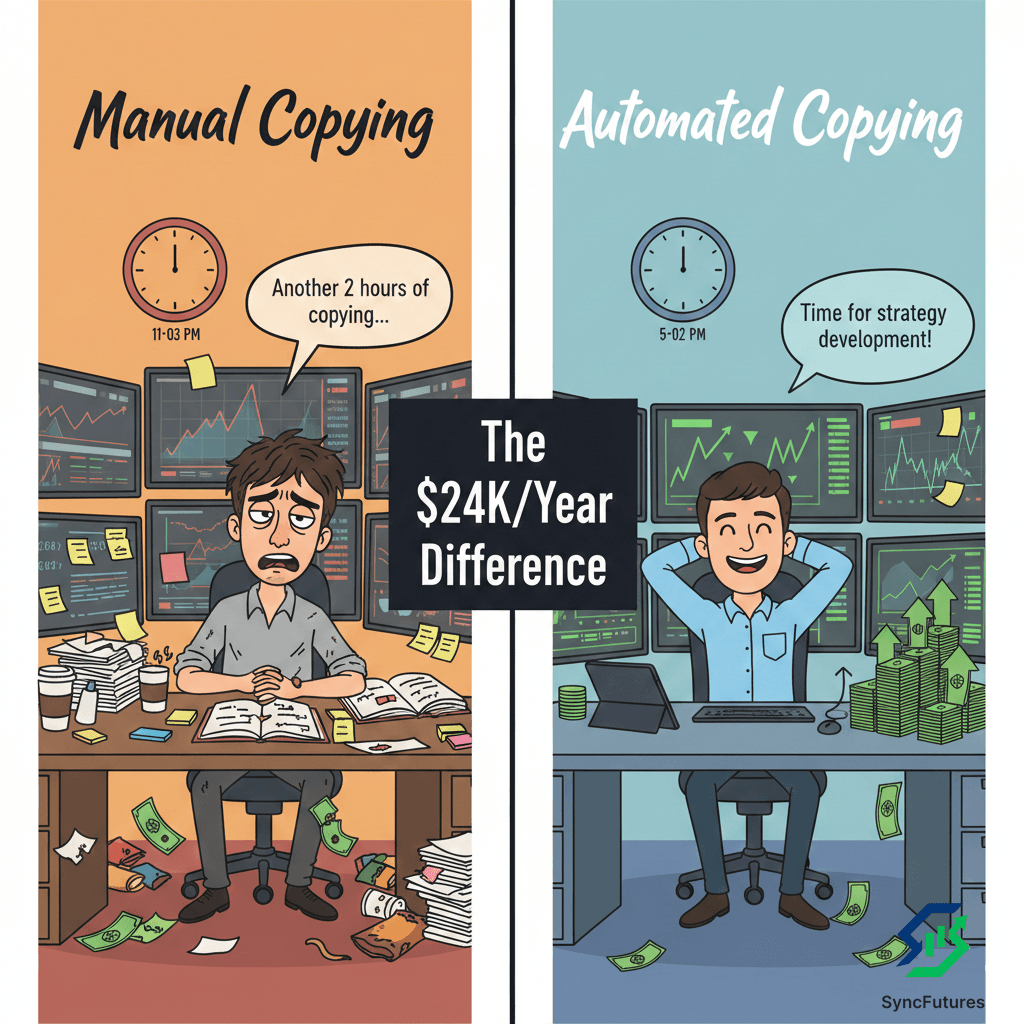
Introduction
Manual trade copying doesn't show up as a line item anywhere. There's no monthly invoice that says "cost of clicking the same order eight times." That's exactly why it's easy to underestimate — the costs are real, but they're distributed across a dozen small frictions instead of one obvious number.
If you're managing more than two or three funded accounts by hand, this guide walks through where those costs actually come from, and gives you a way to estimate your own — not a number we hand you, but a framework you plug your own situation into.
Why Manual Copying Feels Free (But Isn't)
You don't pay a subscription for manual copying, so it's easy to file it under "just part of trading." But every minute spent re-entering the same order on a second, third, or eighth account is a minute not spent reading the market, and every second of lag between your first fill and your last is a second the market had to move against you.
The costs hide in a few specific places:
- Time spent re-executing the same trade across accounts
- Worse fills on the accounts you get to last
- Entry mistakes from repeating the same action many times in a row
- Setups you miss entirely because you were still copying the last one
- Inconsistent execution across accounts that can push one account into a rule violation while the others are fine
Let's go through each one.
Where the Cost Actually Comes From
Time
If you're running eight accounts and trade fifteen times a day, that's up to 120 individual order entries — logging into platforms, entering the same trade repeatedly, checking that each fill matches, and reconciling at the end of the day. That time is pure execution overhead: it doesn't improve your edge, and it's time you're not spending on strategy, review, or rest.
The way to think about this one for yourself: track how many minutes you actually spend copying on a normal trading day for a week, then multiply by what an hour of your time is worth to you. There's no universal number here — it depends entirely on your account count, trade frequency, and how efficient your current process already is.
Execution Delay and Slippage
Futures markets move continuously. The gap between filling your first account and your last account — even 20-30 seconds in a fast market — is time the price can move against the accounts you get to later. Whoever gets copied last tends to get the worst fill.
This is real and directionally always true, but the size of it depends entirely on how liquid and volatile the specific contract you trade is, and how quickly you personally execute. We're not going to hand you a tick-count that applies to every trader on every symbol — if you want to see your own number, compare your first-account fill price to your last-account fill price on your next few manually-copied trades.
Entry Errors
Repetition is where mistakes happen — wrong quantity, wrong side, a stop-loss set on seven accounts but forgotten on the eighth. Most of these get caught quickly and cost little to nothing. Occasionally one doesn't, and when it doesn't, it's usually because you were mid-way through copying to several accounts at once and lost track of which one you were on.
The practical takeaway isn't a fabricated error rate — it's that the risk of this kind of mistake scales directly with how many times you manually repeat the same action per trade. Fewer manual repetitions, fewer chances to fat-finger one of them.
Missed Setups
While you're still copying trade one across your remaining accounts, the market can hand you a second setup you don't have time to take. This is the hardest cost to measure, because you can't put a number on a trade you never saw happen — but it's a real tradeoff of manual execution: the more accounts you run by hand, the more of your attention goes to logistics instead of the market.
Rule Violations From Inconsistent Execution
If your accounts don't all get the same fill, they don't all take on the same risk. An account that got a worse fill on a stop can hit its daily loss limit while an identically-sized account with a better fill doesn't. Inconsistent execution is how one account ends up in violation while the others look fine — not because you traded it differently, but because the copying was inconsistent.
How to Estimate Your Own Number
Rather than assert a single dollar figure that applies to every trader (it doesn't — your account count, symbol, trade frequency, and personal execution speed all change the math), here's a simple way to build your own estimate:
- Track your copying time for one week. Note how many minutes per day you spend logging in, re-entering trades, and reconciling across accounts.
- Multiply by your hourly value. Use whatever you'd genuinely value an hour of focused trading/strategy time at.
- Compare your first and last fill on a few manually-copied trades. That gap, in ticks, times your contract's tick value, times how many trades you copy per day, gives you a real (not assumed) slippage estimate.
- Log any entry mistakes for a week, even small ones you caught immediately. The pattern matters more than any single incident.
- Add it up. Whatever total you land on is specific to your actual trading — which is exactly why we're not printing one number here and asking you to trust it.
For most traders running more than a couple of accounts, that total is meaningfully more than zero, even before you weigh in the stress of a fast market with several open positions to manage by hand.
The Alternative: Automated Trade Copying
The direct fix for all five of the above is removing the manual repetition itself. A trade copier executes your trade once on a master account and replicates it to every follower account automatically — same signal, same timing, no manual re-entry.
SyncFutures is built for exactly this: a cloud-based trade copier for traders running multiple funded accounts, with:
- Parallel execution to every follower account, not sequential
- Per-account quantity multipliers, so account size differences are handled automatically
- One-click flatten across every connected account
- No VPS or desktop software — connect a broker and go
Plans start at $39/month, with a 7-day free trial. Whether that's worth it depends on your own numbers from the framework above — but for most traders running more than two or three accounts by hand, the honest answer is that manual copying costs more than it looks like on the surface.
Frequently Asked Questions
Is manual trade copying really that costly?
It depends heavily on how many accounts you run and how often you trade. For one or two accounts, manual copying is manageable. Past that, the time and slippage costs scale with every additional account, and the framework above is the honest way to find your own number rather than relying on a generic figure.
Does a trade copier eliminate these costs entirely?
It removes the manual-repetition part directly — one execution, replicated automatically, rather than re-entered by hand per account. Slippage from market movement during copying is reduced because replication happens in parallel rather than sequentially, though it isn't literally zero on every trade; execution still depends on broker connectivity and market conditions.
How much does a trade copier cost compared to what I'm losing?
That's genuinely specific to your situation — use the estimate framework above for your own manual-copying cost, then compare it to SyncFutures pricing starting at $39/month for up to 3 connections.
Related guides: